
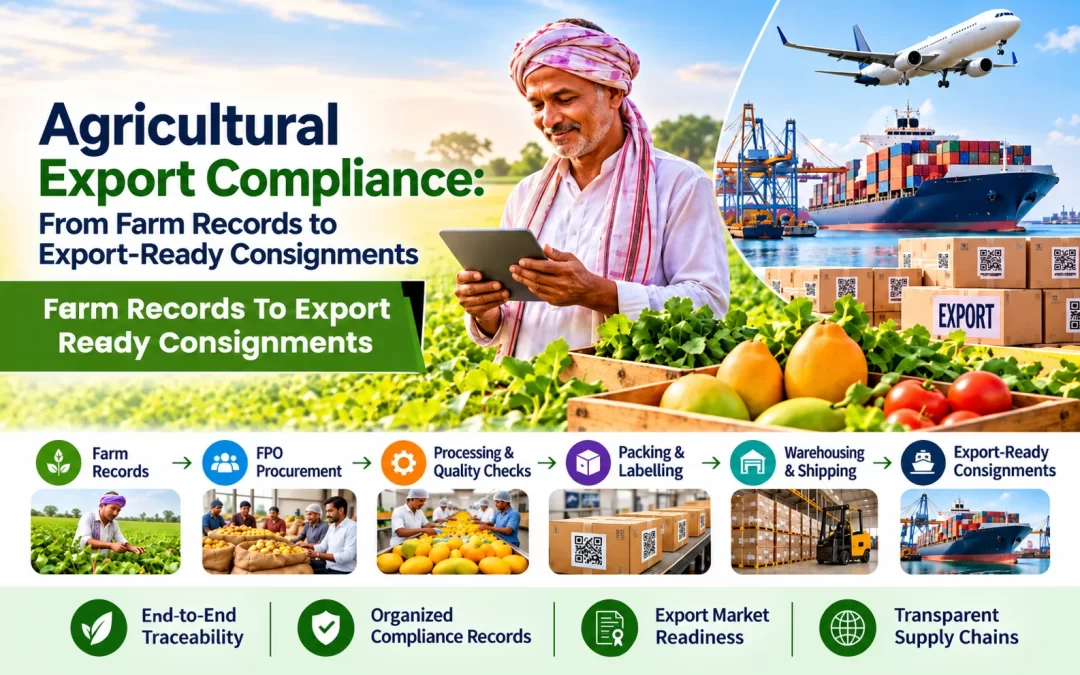
OrganisationsAgricultural exports involve more than producing high-quality crops. Exporters must maintain accurate farm records, track produce across the supply chain, manage compliance documentation, and demonstrate that their products meet the requirements of their target markets. For Farmer Producer Organizations (FPOs), agricultural exporters, and agribusinesses, managing these activities manually can become complicated. Records may be scattered across spreadsheets, paper documents, emails, and different departments, making it difficult to establish a complete picture of a product’s journey.
A digital agricultural traceability system connects these records, helping businesses trace produce from its origin to the final export consignment. In this guide, we explore the importance of agricultural export compliance, the common challenges faced by FPOs, and how digital traceability can help build transparent, organized, and export-ready agricultural supply chains.
Why Is Agricultural Export Compliance Important?
Export buyers increasingly expect reliable evidence of a product’s origin, handling, quality, and supply chain journey. Depending on the product and destination market, businesses may also need to provide specific certificates, inspection records, laboratory reports, and other supporting documentation.
Agricultural exporters need to answer important questions:
- Where was the produce grown?
- Who cultivated it, and when was it harvested?
- How was it processed, graded, packed, and stored?
- Can the business trace a particular batch back to its source?
- Are the relevant certificates and documents available for verification?
- Can the business identify the products associated with a quality or safety issue?
When this information is incomplete or difficult to retrieve, businesses may experience audit delays, challenges in responding to quality issues, and difficulties demonstrating compliance with buyer or regulatory requirements. Maintaining reliable records throughout the supply chain helps agricultural businesses prepare documentation, improve accountability, and respond more efficiently to verification requests.
Common Agricultural Export Compliance Challenges Faced by FPOs
FPOs often aggregate produce from multiple farmers and coordinate activities across collection centres, processing facilities, warehouses, and export partners. Without connected records, maintaining traceability throughout these operations can be challenging.
1. Disconnected Farm and Harvest Records
FPOs collect agricultural produce from multiple farmers, plots, and harvesting cycles. When produce is pooled at collection centres, the identity of individual lots can become difficult to maintain. Without linked farmer, plot, harvest, and procurement records, tracing a consignment back to its agricultural origin becomes more complicated.
2. Scattered Export Compliance Documents
Certificates, laboratory reports, invoices, inspection records, and shipping documents may be stored in different systems or physical locations. Finding the correct document during an audit, buyer verification, or export documentation process can consume valuable time.
3. Limited Visibility Across the Agricultural Supply Chain
Agricultural produce passes through several stages, including procurement, aggregation, processing, grading, packing, warehousing, and shipping. If each stage maintains separate records, connecting the complete product journey becomes difficult. This can create gaps between the original farm records and the information associated with the final export consignment.
4. Difficulty Identifying Affected Batches
When a quality issue occurs, businesses need to identify which lots are affected and where those lots have moved. Without lot-level traceability, investigating a problem involving a specific batch may require reviewing large volumes of records or withdrawing products that are not affected.
5. Inconsistent Data and Manual Reporting
Manually transferring information between spreadsheets, registers, and documents can introduce errors, duplicate entries, and inconsistencies in quantities, dates, lot numbers, or product descriptions. Standardised digital records can help reduce these gaps and make traceability information easier to retrieve.
How Does Digital Traceability Support Agricultural Export Compliance?
A digital traceability platform connects information recorded at different stages of the agricultural supply chain. Instead of treating farm records, procurement details, processing information, and shipping documents as independent records, the system links them through lot and batch identities.
1. Farm-Level Data Collection
The process begins with farmer registration, plot mapping, crop details, and cultivation records. Farm activity logs may include:
- Farmer and plot identification.
- Crop and cultivation details.
- Approved agricultural inputs and application dates.
- Harvest dates and declared quantities.
- Quality observations and relevant safety checks.
These records help establish the origin and production history of agricultural produce. The specific information collected should reflect the crop, production system, buyer requirements, and applicable regulations.
2. FPO Procurement and Produce Aggregation
When produce arrives at a collection centre, the FPO can record farmer-wise weighment, accepted quantities, rejected produce, grades, and procurement transactions.
When produce from multiple farmers is combined, the system should preserve the relationship between the original harvest lots and the newly created aggregated lot.
This parent-child lot relationship helps maintain traceability even when produce moves between locations or is combined during handling.
3. Processing and Quality Management
During processing, businesses can record incoming lots, processing activities, yield, wastage, quality checks, and laboratory results.
When an input lot is converted into a processed output, the system should link the output batch to its source lots and relevant processing records.
This connection helps businesses investigate quality issues and demonstrate how agricultural produce was handled before packing.
4. Packing and Product Identification
Packing records may include pack dates, net weight, grade, product specifications, packaging details, and batch information.
Unique product and logistics identifiers can help connect individual units, cases, and pallets to their associated traceability records.
Where appropriate, QR codes and GS1 identification standards can support product identification and access to relevant digital information. A QR code alone does not guarantee traceability; the underlying records and identifier relationships must also be maintained.
5. Warehousing, Dispatch, and Shipping
Shipment records can connect packed products with pallet details, dispatch information, transport records, export documentation, and receiving information.
Recording these events creates a more complete view of the consignment’s movement through the supply chain.
Depending on the workflow, businesses may also maintain information about storage conditions, shipment quantities, dispatch dates, and delivery confirmation.
6. Consignment-Level Traceability and Document Retrieval
When an export buyer or auditor requests information, the business should be able to identify the relevant consignment and retrieve its associated records.
These may include source farm and harvest details, procurement records, processing batches, quality reports, packing information, applicable certificates, and shipment documents.
The objective is to make traceability evidence easier to retrieve and verify without manually searching through disconnected records.
Key Standards and Records in Agricultural Export Compliance
Agricultural export requirements vary according to the product, destination country, buyer, production method, and applicable regulations. Businesses should verify the current requirements for each product-market combination before shipping.
The following frameworks and systems may be relevant to agricultural traceability and export documentation.
APEDA HortiNet and Phytosanitary Documentation
APEDA’s HortiNet system supports applicable processes for specified horticultural export products and associated traceability or certification workflows.
Phytosanitary documentation may be required for regulated plant products, depending on the destination country’s import conditions and the applicable inspection and certification process.
Exporters should confirm whether the relevant product and shipment fall within the applicable system and requirements.
GlobalG.A.P. and IndG.A.P.
GlobalG.A.P. and IndG.A.P. are farm assurance frameworks that may be relevant to participating agricultural operations and buyer requirements.
Their applicability depends on the scheme, certification status, product, scope, and applicable market or customer requirements.
Maintaining farm activity and input records can support the recordkeeping processes associated with relevant assurance requirements.
NPOP Organic Certification
India’s National Programme for Organic Production (NPOP) provides a framework for organic production certification and related requirements.
Businesses exporting products as organic should verify the applicable certification, scope, transaction documentation, and destination-market recognition requirements.
Digital records can help associate relevant certification information with farms, products, and consignments, but software does not replace certification or mandatory verification.
FSSAI and FoSCoS
The Food Safety and Standards Authority of India (FSSAI) administers India’s food safety regulatory framework. FoSCoS is its Food Safety Compliance System.
Applicable food businesses must determine their licensing, registration, and compliance obligations based on their activities and the relevant rules.
Food safety records and supporting documents can be organized within a digital workflow where appropriate.
GS1 Identification Standards
GS1 standards can help businesses identify products, locations, and logistics units consistently across supply chain partners.
Relevant identifiers and standards include:
- GTIN: Identifies trade items.
- SSCC: Identifies logistics units, such as pallets or shipping units.
- GLN: Identifies parties and locations.
- GS1 Digital Link: Connects GS1 identifiers to online information and digital resources.
The appropriate identifiers depend on the product, packaging hierarchy, and trading-partner requirements.
GS1 EPCIS 2.0
GS1 EPCIS 2.0 is a standard for capturing and sharing supply chain event information.
It can help organizations exchange information about what happened to a product, when and where an event occurred, and its relevant business context.
For organizations working with multiple supply chain partners, standards-based event data can support interoperability when participating systems implement compatible processes.
Important: A digital traceability platform can help organize and connect records, but using software does not automatically guarantee export compliance. Mandatory inspections, certifications, licenses, declarations, and regulatory approvals remain subject to the applicable rules and authorities.
How Scalion Helps Connect Agricultural Traceability and Export Compliance
Scalion’s agricultural traceability approach connects farm management, FPO management, product traceability, and export compliance support within a connected digital workflow.
Its capabilities, as described in the Traceability Systems for FPOs presentation, include the following areas.
Farm Management
Maintain farmer and plot records, crop calendars, cultivation activities, and harvest information.
Organized farm records can help establish the production history of agricultural produce and provide a starting point for downstream traceability.
FPO Management
Manage member information, procurement, inventory, purchases, sales, loans, and reporting.
Connecting procurement records with farmer and harvest information can help FPOs maintain more consistent records when aggregating produce from multiple sources.
End-to-End Agricultural Traceability
Connect harvest lots with aggregation, processing batches, packed units, cases, pallets, and shipments.
Maintaining relationships between lots and their downstream outputs can help businesses trace a consignment through successive stages of the supply chain.
Export Compliance Support
Organize consignment documentation, monitor relevant certification records, check document fields, and assess applicable trade requirements.
The usefulness of these capabilities depends on the configured workflow, available data, and applicable product and destination-market rules. Businesses should validate requirements with the relevant authorities, certification bodies, and export partners.
By connecting information across these activities, Scalion aims to help FPOs and agricultural businesses improve supply chain visibility, organise traceability records, and prepare for export documentation and verification processes.
Learn more at https://www.scalion.com/.
Practical Steps to Prepare an FPO for Export Traceability
FPOs do not need to digitise every product and process at once. A focused implementation can help establish a practical foundation before expanding across additional products and markets.
Step 1: Identify the Product and Target Market
Choose the agricultural product and destination market. Understand the buyer’s requirements, applicable export regulations, certification obligations, and documentation requirements.
Step 2: Review Existing Farm and Supply Chain Records
Identify gaps in farmer registration, plot information, harvest data, procurement records, certificates, processing records, and shipment documentation.
Determine which information is already available and which records need to be standardized.
Step 3: Define Traceability Events
Determine what information must be recorded at harvest, collection, aggregation, processing, packing, dispatch, and receipt.
Assign responsibility for recording and verifying information at each stage.
Step 4: Establish Lot Identification Rules
Define how lots will be identified, combined, split, processed, and repacked.
Ensure that aggregated produce and processed outputs remain linked to their source records. Establish procedures for correcting errors without losing the history of relevant changes.
Step 5: Run a Pilot
Begin with one product, one supply chain, and one export market.
Use the pilot to test the data collection process, lot relationships, document organization, and coordination between farmers, FPO staff, processors, and exporters.
Step 6: Test Traceability and Document Retrieval
Conduct a mock traceability exercise using a selected consignment.
Check whether the team can retrieve its source farm records, harvest and procurement information, processing history, quality documents, packing records, and shipment information within a reasonable time.
Where appropriate, test both backward traceability from a shipment to its source and forward traceability from a source lot to the consignments that contain it.
Step 7: Expand and Improve Gradually
Use the pilot results to improve data quality, staff training, operating procedures, and reporting before introducing the system across additional products, locations, and markets.
Review the process periodically as buyer expectations, standards, and applicable regulations change.
Conclusion: Build a More Traceable, Export-Ready Agricultural Supply Chain
Agricultural export compliance depends on more than collecting documents before a shipment leaves the warehouse. It requires reliable information connecting the farm, FPO, processing facility, pack house, warehouse, and buyer.
For FPOs and agricultural exporters, digital traceability can help preserve product identity, organize compliance records, improve supply chain visibility, and respond more effectively to buyer questions and quality issues.
The goal is simple: make every consignment easier to trace, verify, and document.
With a structured implementation and suitable digital tools, agricultural businesses can build a stronger foundation for transparent supply chains and export-market readiness.
Ready to Improve Your Agricultural Traceability?
Discover how Scalion connects farm management, FPO operations, end-to-end traceability, and export compliance support.
Visit Scalion’s website to learn more about the platform.
Trace. Verify. Comply. Protect.
 Frequently Asked Questions
What Is Agricultural Export Compliance?
Agricultural export compliance is the process of meeting the applicable legal, regulatory, certification, food safety, phytosanitary, documentation, and buyer requirements for exporting agricultural products to a particular market.
Requirements vary by product, destination, and shipment.
Why Is Traceability Important for Agricultural Exports?
Traceability helps businesses establish where produce originated, how it was handled, which batches were created, and where products were shipped. Reliable traceability records can support buyer verification, quality investigations, audits, and applicable regulatory processes.
How Can FPOs Improve Agricultural Traceability?
FPOs can improve traceability by maintaining consistent farmer and plot records, recording harvest and procurement details, assigning unique lot identifiers, linking aggregated lots to their sources, and recording processing, packing, and shipment events.
Digital systems can help connect these records across different operational stages.
What Documents Are Required for Agricultural Exports From India?
The documents depend on the product and destination market. They may include commercial invoices, packing lists, shipping documents, applicable export declarations, certificates of origin, phytosanitary certificates, inspection reports, laboratory reports, and relevant certification documents.
Exporters should verify the current requirements with the relevant authorities, customs professionals, certification bodies, and destination-market importers.
What Is Digital Agricultural Traceability Software?
Digital agricultural traceability software records and connects information about agricultural production, procurement, processing, packaging, storage, and shipping.
Depending on the platform, it may also support lot identification, document management, quality records, reporting, and consignment-level information retrieval.
How Does Lot-Level Traceability Work?
Lot-level traceability assigns an identifier to a defined quantity of produce and maintains its relationship with related activities and records.
When lots are combined, split, processed, or repacked, the system records the relationships between the original lots and the resulting lots or batches.
Can QR Codes Help With Agricultural Export Traceability?
Yes. QR codes can provide a convenient way to access product or consignment information when linked to suitable identifiers and digital records.
However, a QR code by itself does not establish the accuracy of the underlying information or guarantee regulatory compliance. The records, identifier structure, and access controls must be maintained appropriately.
Does Digital Traceability Automatically Guarantee Export Compliance?
No. Digital traceability helps organize and retrieve information, but it does not automatically satisfy every legal or buyer requirement.
Businesses must still obtain applicable licenses, certifications, inspections, approvals, and documentation and verify that their operations meet the rules for the target market.
What Is the Role of GS1 Standards in Agricultural Traceability?
GS1 standards provide common methods for identifying products, locations, and logistics units and for sharing supply chain information.
GTIN, SSCC, GLN, GS1 Digital Link, and EPCIS can support identification and information exchange when implemented appropriately across participating organizations.
How Can Scalion Support FPOs With Agricultural Traceability?
Scalion’s described capabilities include farm management, FPO operations, end-to-end traceability, and export compliance support. These functions can help connect farmer, plot, harvest, procurement, processing, packing, and shipment records within a more organized workflow.
FPOs should evaluate the platform’s specific features, configuration, and suitability against their operational needs and applicable export requirements.