Learn why agricultural traceability is becoming important for FPOs and exporters and how farm-to-market visibility can build buyer trust and support export requirements.
Agricultural Traceability: Why Export Buyers Need It
Exporting agricultural products is no longer only about producing good-quality products. Buyers increasingly want evidence of where the product came from, who produced it, how it was handled and whether its journey can be verified. For FPOs and agricultural exporters, this makes agricultural traceability an important part of building trust in international markets.
The key question is: Can you prove the journey of your product from farm to global market?
What Is Agricultural Traceability?
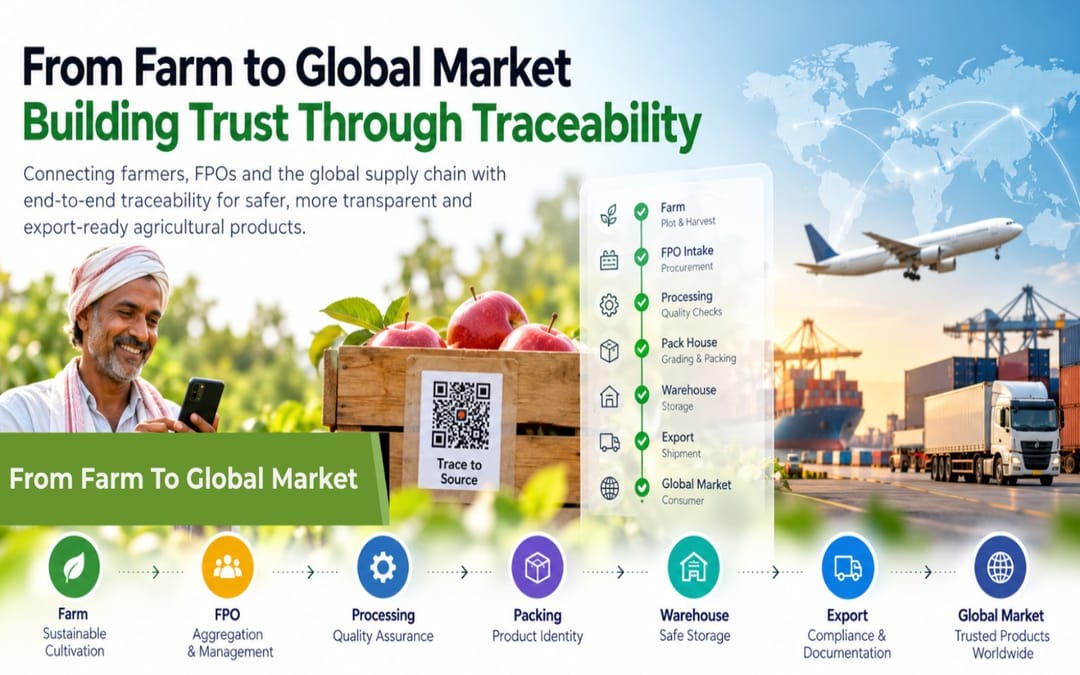
Agricultural traceability is the ability to track a product through the different stages of its journey. A typical journey can look like: Farm → FPO Intake → Processing → Pack House → Warehouse → Export → Buyer. A traceability system connects information from these stages so that the origin and movement of a product can be verified. The PDF describes this as creating a connected record across the supply chain. Traceability Systems for FPOs.
Why Is Traceability Important for Exporters?
1. Know Where the Product Came From
When products from multiple farmers are pooled together, it can become difficult to identify the original farm, grower and harvest details. A traceability system maintains the connection between the farmer, plot, crop and harvest lot.
2. Make Recalls More Targeted
Without lot-level traceability, a quality problem may require a broad product withdrawal. With connected lot records, businesses can identify the relevant product journey and take more targeted action.
3. Improve Export Buyer Confidence
International buyers increasingly want evidence rather than simple assurances. They may want to understand:
- Where was the product produced?
- Who produced it?
- When was it harvested?
- How was it handled?
- Can its journey be verified?
- Does it meet the required market standards?
These questions are at the heart of modern agricultural traceability.
From Farmer to Export Market
A modern traceability system can connect information beginning at the farm. For example: Farmer → Plot → Crop → Harvest → Lot → Processing → Packing → Shipment. The PDF demonstrates how a harvest record can contain farmer information, plot information, crop, grade, quantity, harvest date and safety information. Traceability Systems for FPOs: This creates a stronger digital record of the product’s origin.
Why FPOs Should Think About Traceability
For an FPO, traceability is not only about exports. It can also help create better visibility into:
● Farmer records
● Crop production
● Procurement
● Inventory
● Harvests
● Sales
● Supply-chain movement
Compliance. A connected FPO management and traceability system can bring these activities together rather than keeping information across disconnected records. Traceability Systems for FPOs
The Future of Agricultural Exports
The future of agricultural exports is increasingly about proving the journey of the product, not simply producing it. For FPOs and exporters, agricultural traceability can become a foundation for: Trust + Transparency + Compliance + Market Access. In the next article, we will look at how a traceability system works from farmer onboarding to harvest, processing, packing and shipment. Want to understand how traceability can work for your FPO or agricultural business? Talk to Scalion Agritech.
 Frequently Asked Questions
What is agricultural traceability?
Agricultural traceability is the ability to track a product through the different stages of its journey—from the farm, through FPO intake, processing, pack house, warehouse, and export, all the way to the end buyer. It creates a connected digital record that verifies origin and movement.
Why is traceability critical for agricultural exporters?
International export buyers increasingly demand hard evidence rather than simple verbal assurances. Traceability allows exporters to prove where a product was produced, who grew it, harvest dates, handling methods, and compliance with strict international market standards.
How does a traceability system help during product recalls?
Without lot-level traceability, a single quality issue can force a broad, costly product withdrawal. With connected lot records, businesses can pinpoint the exact product journey, identify the affected batch, and execute targeted, localized actions.
Why should FPOs implement a traceability and management system?
Beyond supporting exports, a connected FPO management system provides complete internal visibility into farmer records, crop production, procurement, inventory, harvests, sales, supply-chain movement, and compliance, eliminating disconnected record-keeping.
What kind of information does a modern harvest record contain?
A modern harvest record typically contains farmer information, plot details, crop type, grade, quantity, harvest date, and safety information, creating a robust digital record of the product’s true origin.